
TL;DR
For professional owners of medium-to-large PV plants, the choice between manual and robotic cleaning is a strategic asset management decision that directly affects yield, safety and TCO. Pollution from industrial, agricultural and urban environments often causes 2-12 per cent yield losses, making data-driven maintenance crucial.
- Manual cleaning is suitable for smaller, complex or fragmented roofs with many obstacles, and combines flexibility with visual inspections.
- Robotic cleaning pays off on large, contiguous roofs and solar farms due to economies of scale, uniform quality and less height work.
- Osmosis water and certified procedures prevent damage, residue and accelerate module obsolescence.
- Data analysis, inspections and yield loss calculations determine optimal frequency and method, supported by reporting for audits and ESG.
Solarco offers a data-driven mix of manual and robotic cleaning, fully embedded in a maintenance strategy for maximum, demonstrable yield.
For professional owners and operators of medium to large PV plants, the choice between manual vs robotic cleaning solar panels is crucial: it directly affects efficiency, safety and asset life, and determines how maintenance is planned and accounted for within audits and ESG objectives.
Manual vs robotic solar panel cleaning: what's at stake?
The trade-off between manual and robotic cleaning is an asset management decision, not just a practical one. Manual cleaning refers to professional manual cleaning with filtered or osmosis water, brushes and suitable fall protection; robotic cleaning refers to autonomous or semi-autonomous machines that systematically clean rows of panels. For operators, it is about total return over the lifetime, predictability of maintenance, audit and ESG requirements, and mitigating safety risks when working at height. Therefore, it is important to engage an experienced partner who can back up “solar panel cleaning company” with data and reporting.
- Yield and yield retention: Proper cleaning minimises invisible yield loss and protects module life.
- Security and compliance: manual interventions increase risks, making certified procedures and training essential.
- Predictability and reporting: robotic systems deliver consistent frequencies and reproducible reports that support audit and ESG requirements.
- Scalability and total cost of ownership: for large or dispersed installations, robotisation often delivers lower TCO and faster implementation over the lifecycle.
For asset and facility managers, this means that the choice should not rest on one-off costs, but on measurable impact on yield, risk and compliance. A professional solar panel cleaning company can quantify these elements, supporting informed decisions within the maintenance solar panel industry framework. Ultimately, the right choice is the one that balances yield, safety and predictability for your portfolio.
How pollution affects the efficiency of solar panel installations
On industrial rooftops, farms and solar parks, pollution slowly accumulates, often without immediate alarm from monitoring. Yet every layer of dust, fine dust or ammonia precipitation reduces light penetration, reducing efficiency and shifting the payback period. Understanding these invisible losses and the frequency of contamination determines when cleaning becomes useful and which approach within manual vs robotic solar panel cleaning is most appropriate.
Main sources of pollution
At logistics and industrial sites, truck traffic, forklifts and smokestacks create a constant supply of dust and particulates that settle on the glass layer. On farms, manure storage, stables and fans play a role, with ammonia and organic particles forming persistent films. In urban environments, traffic emissions and industrial precipitation add to this, while in solar parks, sand and pollen are also an important factor.
- Logistics and industry: fine dust, rubber particles, smoke and industrial precipitation on large roof surfaces.
- Agriculture: ammonia, organic matter and aerosols from barns and manure storage on barn and shed installations.
- Solar parks: dust, pollen and sand, especially during dry periods and near unpaved roads.
- Urban roofs: soot, traffic emissions and fine aerosols forming a thin film.
- Specific sources: silos, cooling towers or ventilation systems that create additional outlets locally.
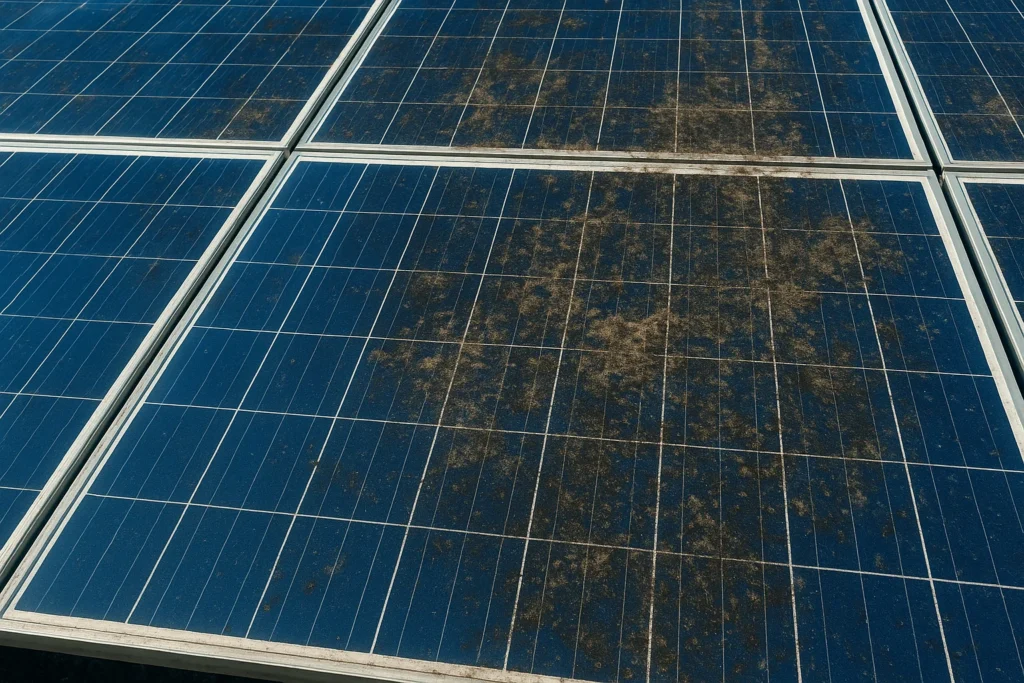
This mix of sources explains why dirty modules can still look visually acceptable, while there is already significant efficiency loss at contaminated solar panels occurs. Sector, roof pitch, orientation and local wind patterns determine the contamination profile, which directly impacts the frequency and method of maintenance. This is precisely why solar panel cleaning makes sense if you systematically consider which source is dominant on a site-by-site basis and which professional approach best suits it, rather than relying on the idea that rain will do enough by itself.
Impact on yield and lifespan
Measurements at commercial plants in Western Europe show typical yield losses of 2 to 5 per cent after a year without maintenance, even in relatively clean environments. At agricultural sites and heavy industry, this often rises to 8 to 12 per cent in practice, with peaks above 15 per cent in extreme pollution or prolonged drought. This effect is only partially visible in monitoring, as weather conditions complicate comparisons, so yield losses are sometimes not seen until a targeted before-after measurement or analysis of why clean solar panels becomes clear.
Economically, cleaning becomes interesting once the combined losses due to contamination exceed the cost of professional intervention over the life of the project. For large roofs and solar farms, a structural 5 per cent loss quickly translates into tens of thousands of kilowatt hours per year, making the best way to clean solar panels a strategic decision. With tools such as a calculator for dirty solar panels and guidelines for how often to clean solar panels makes this impact visible and allows you to schedule maintenance cyclically and with evidence.
Manual cleaning of solar panels: method, advantages and limitations
Professional manual cleaning is substantially different from someone with a bucket of water on the roof. It involves controlled use of osmosis water, soft brushes, telescopic poles and certified fall protection, carried out by teams who know exactly what load panels can handle. This approach offers great flexibility, but also requires more labour per square metre than automated methods. For professional owners, this choice is all about control, reproducibility and minimal site disruption.
When manual cleaning is sufficient
For smaller commercial roofs, highly fragmented installations or sites with many upstands, skylights and ventilation units, manual solar panel cleaning often remains the most efficient choice. An experienced crew can move purposefully around obstacles, take edges and hard-to-reach areas and treat locally stubborn deposits. For more modest industrial installations, carports or carwash roofs, the lower start-up cost makes that periodic, business solar panel cleaning by hand remains economically defensible. At the same time, the same crew can take inspection photos and visual checks, which is useful for planning wider maintenance.
- Smaller or medium-sized roofs with complex geometry or many obstacles per unit area.
- Installations with limited contiguous surfaces, e.g. spread over several roofs.
- First thorough cleaning after construction activities or roof works with cement and dust residues.
- Situations with localised persistent contamination requiring targeted treatment or post-treatment.
- Sites where robot logistics (supply, set-up, transport) are difficult or risky.
In these situations, the lower mobilisation costs and flexibility of a manual team outweigh the longer execution time per string. The focus thereby shifts from a one-off solar panel cleaning price to the total maintenance cost over several years, including yield retention and avoided failures. Those with several sites in a portfolio can thus weigh up per site where manual remains the best choice and where scaling up to robotics provides more value within the broader framework of manual vs robotic solar panel cleaning.
Risks and concerns in manual cleaning
Manual work closer to the panel also increases certain risks. Excessive point pressure on the glass panel, supporting on the frame or walking on the roof surface can cause microfractures that only manifest themselves later as hotspots or reduced yields. In addition, with inexperienced cleaning crews, there is a risk that incorrect cleaning agents, such as detergent on solar panels, are used or that tap water with high hardness is used, which leaves veil and residue. An apparently clean panel can thus still produce light loss and accelerated ageing.
Safe solar panel cleaning therefore requires clear procedures around height work, fall protection and separation of traffic zones on site. Certified crews specifically use cleaning equipment for solar panels and work with osmosis water as standard, as described in the guidelines for correct maintenance of solar panels. If you want to structurally secure these preconditions, it is better to opt for a permanent maintenance partner than for separate, occasional cleaning actions, so that the quality of manual cleaning remains at the same level over its entire lifespan.
Robotic solar panel cleaning: when is automation the best choice?
Where areas become large and repetition counts, robotic solar panel cleaning offers a different scale to manual work. On flat roofs, large logistics halls and solar parks, a robot can draw wide lanes in a single pass, with constant pressure and water dosing. This makes it feasible to clean installations with tens of thousands of panels predictably and safely within a limited time frame without placing a heavy burden on the site organisation.
Operation and types of cleaning robots
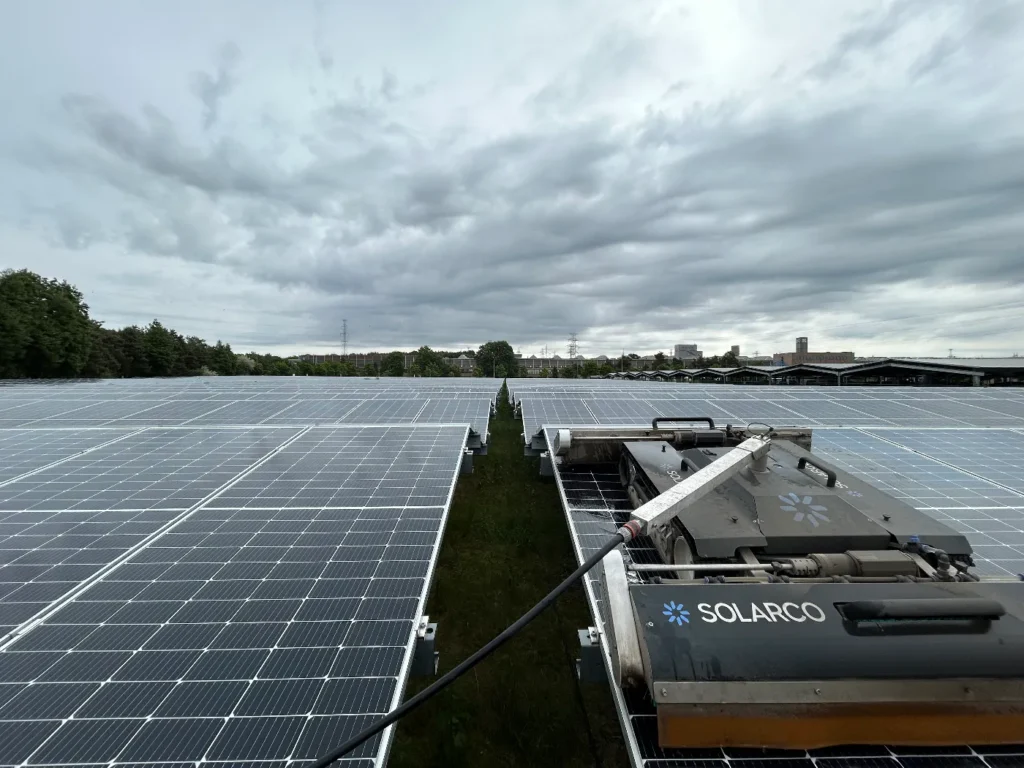
In practice, these are usually lightweight robots that ride over panels on rubber tracks or wheels, powered by batteries and controlled via remote control or tablet. They combine a rotating brush with a continuous flow of osmosis water, so dirt is loosened and disposed of directly without chemicals or high pressure, similar to the principles from osmosis cleaning of solar panels. At solar farms and large ground installations, some systems run on rails along the rows, while on rooftops compact robots are brought onto the roof surface via hoses and cables.
Many asset managers consider buying Robot solar panels or buying a system like a GEKKO Solar robot, but the technical match with the roof and laying plan is more important than the brand per se. At cleaning of ground-mounted solar parks elongated robots that take large strips in one direction often perform best, while for roof installations compact, lightweight robots with high manoeuvrability are needed. Proper analysis of slope, string configuration, obstacles and available water and power points prevents an expensive robot from ultimately reaching fewer panels than anticipated.
Benefits and boundary conditions on large installations
On large roofs and solar farms, the advantages lie mainly in scale, uniformity and safety. A robot can operate at constant pressure, which puts less strain on panels than manual brushing, while ensuring uniform contact time with osmosis water. In addition, you reduce the number of staff who need to be physically on the roof, bringing significant gains in safety records and compliance with internal HSE guidelines and contractor policies.
Robotic systems are less suitable on very small or highly fragmented installations, roofs with many level differences or limited walkways, and sites where cables or obstacles restrict passage. Cost-effective deployment requires a minimum contiguous area and ideally a roof slope and roughness that allow controlled movement of the robot. In comparing manual vs robotic solar panel cleaning, you therefore weigh up not only yield and safety, but also the repeatability, accessibility and logistics of each turn within your multi-year schedule.
Way to clean solar panels at Solarco
At Solarco, we do not start from a preference for a particular technique, but from data on contamination, yield and safety at each site. In this way, the choice between manual and robotic cleaning is always underpinned within the customer's broader maintenance policy, rather than a one-off cleaning action with no measurable effect.
Data-driven choice between manual and robotic
The analysis often starts with monitoring data and inspections, complemented by photos of the site and environmental features. Based on such factors as orientation, roof type, sector and historical yield, we compare actual production with theoretical expectation, possibly supported by a solar panel inspection or yield loss calculation. We then determine for each cluster whether a flexible manual team is sufficient or whether scale and degree of contamination justify a robotic approach, taking into account your budget and risk profile.
For large solar parks and extensive rooftop installations, Solarco deploys battery-powered robots certified by leading module manufacturers to ensure that the load on the glass and frames remains within safe margins. These robots clean large fields quickly and evenly, while smaller or complexly laid-out installations are often deliberately cleaned manually to include every panel and detail. Thus, our approach aligns with data-driven maintenance strategies of asset managers who want to maximise manual vs robotic cleaning solar panels over the lifetime of their portfolio.
Safety, certification and reporting at Solarco
Safety is paramount, both for our teams and for your facilities. Our staff are trained for working at height, use certified fall protection and follow set procedures in line with the safety structure of industrial sites. In both manual and robotic professional cleaning of solar panels we work with osmosis water as standard, as described in our explanation of streak-free cleaning, leaving no harsh chemicals or residue.
After each intervention, you will receive a clear report with before-and-after photos, pollution findings and any points of interest for future maintenance of solar panels. This makes it easier to justify decisions around cleaning solar farm, rooftop or ground installation in audits, ESG reports and budget cycles. In this way, Solarco grows into a solar panel maintenance partner that not only cleans, but also adds insight and predictability to your energy assets.
Choosing between manual and robotic cleaning for your solar panels
The choice between manual and robotic cleaning touches directly on yield, safety and TCO for professional owners of medium to large installations. In practice, it is all about the right tool at the right scale: the “manual vs robotic solar panel cleaning” debate is about predictability of yield, inspectability and compliance with maintenance and ESG requirements. Asset managers should therefore use a decision framework that links area, contamination profile and safety risks to long-term yield.
- Area and scale, small arrays often manual, large roofs and parks often robotic
- Pollution profile, fine dust and industrial precipitation require higher frequency and uniform cleaning
- Accessibility and roof geometry, complex roofing can remain manual work
- Frequency and predictability, automatic robots offer regularity and lower operational variation
- Safety, audits and ESG, mechanical cleaning minimises height and fall risk for staff
Use this simple grid as an initial filter: scale and contamination determine the direction, accessibility and safety or audit requirements refine the choice, and for a responsible decision, ultimately what counts most is the impact on annual yield and manageable total cost. Solarco helps portfolio owners make the choice between manual vs robotic cleaning solar panels sustainable with metrics and a clear TCO perspective, ensuring efficiency and safety together. Would you like to have this calculated for your installations and receive a tailored maintenance proposal, Get in touch.
FAQ
How do I choose between manual and robotic cleaning for my plant?
Choose based on scale, pollution profile, roof geometry and safety: smaller, fragmented or complex roofs are often more efficient to clean manually, while large contiguous rooftops and solar parks usually benefit from robotic cleaning because of lower TCO, uniformity and less risk for staff. Have a data-driven analysis carried out (monitoring, inspections, yield loss calculation) to inform the choice.
How often should solar panels be cleaned?
There is no fixed frequency; it depends on local pollution sources and targets. In relatively clean environments, deferral leads to an average of 2-5% annual loss; at industrial or agricultural sites, it can reach 8-12% or more. Use monitoring and tools such as a yield loss calculator and plan cleaning intervals cyclically based on measurable yield impact.
<h3Is osmosis water really necessary for professional cleaning?Yes. Osmosis water prevents streaks and residue that tap water or unsuitable cleaning agents (such as washing-up liquid) can leave behind. Certified cleaning procedures use osmosis water to avoid permanent veiling and additional aging; see also our explanation on osmosis cleaning and the dangers of improperly used funds.
Are cleaning robots safe for solar panels and frames?
When robots are certified and technically well matched to the laying plan, they are safe and often less stressful than manual brushing. Solarco deploys battery-powered, module manufacturer-certified robots that keep pressure and contact time within safe margins; however, the technical match with slope, obstacles and string configuration is crucial for success.
What reporting and evidence do I get after cleaning for audits and ESG?
After each intervention, you will receive a clear report with before-and-after photos, findings on contamination, method implemented and recommendations for future frequency. This documentation supports audits, ESG reporting and budget decisions and makes the choice between manual vs robotic cleaning insightful and verifiable.


 Dutch
Dutch  English
  French
  German