
TL;DR
Lichen on solar panels is not an ordinary dirt, but a growing biological layer that takes away light, retains moisture and thus affects efficiency, lifetime and guarantees of PV installations. Especially on logistics, industrial and agricultural roofs, it can lead to hotspots, microcracks and additional inspection costs.
- Risks increase with thick, uneven fouling covering entire cell zones.
- DIY methods using high pressure, abrasives or household products often cause invisible damage.
- Professional cleaning uses soft materials, osmosis water and controlled biosolids applications based on inspection and data.
- The business case relies on measured return loss, cost calculation and remaining life, not on photos alone.
Integrate lichen cleaning into a data-driven maintenance plan with periodic inspections so that each intervention demonstrably contributes to efficiency, safety and long-term cost control.
If you're looking for lichen solar panel removal, you want to know quickly whether the problem threatens your yield and what approach is safe and effective; this article explains in matter-of-fact, measurable terms what lichen does to panels, why it is more persistent than ordinary soiling, and what impact it has on medium and large PV installations.
Lichens on solar panels: what is it and why is it a problem?
What exactly is lichen?
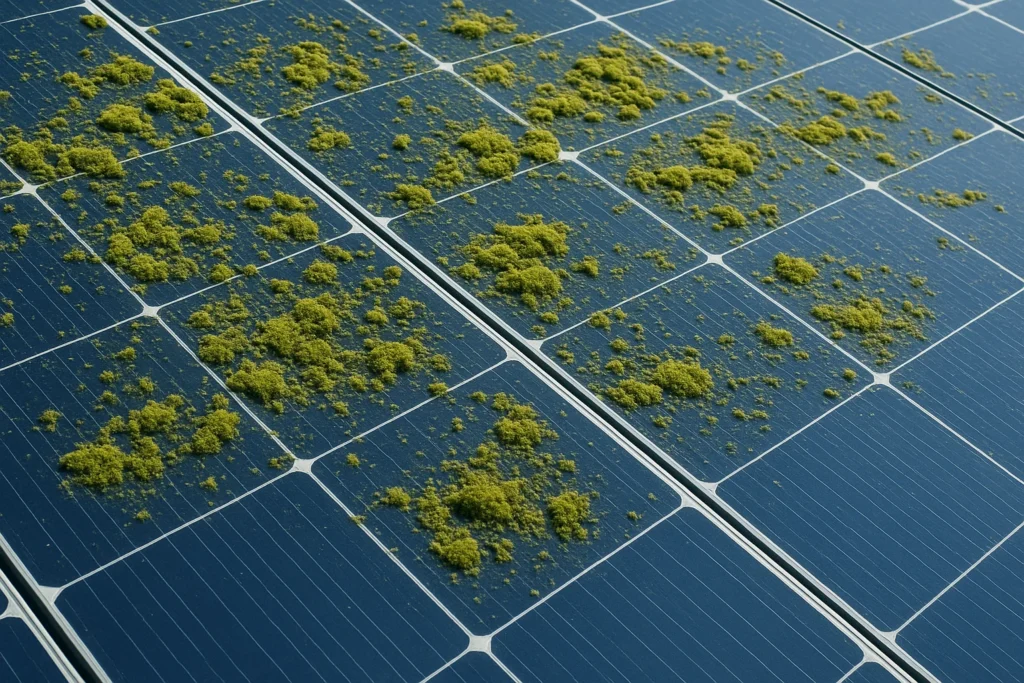
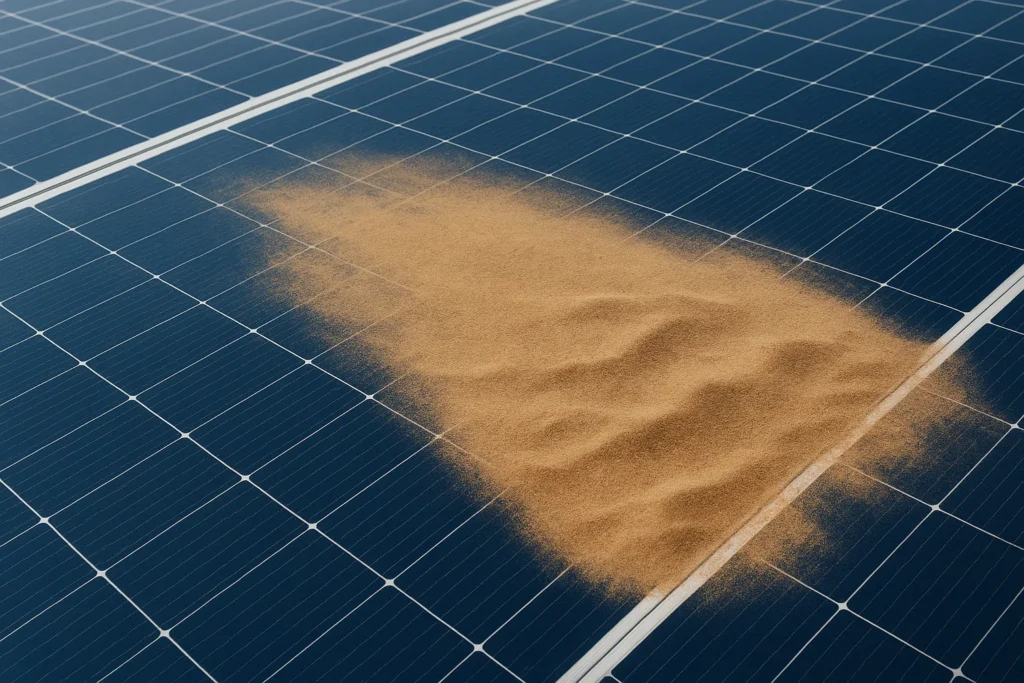
Lichen is a biological deposit of algae, fungi and mosses that adheres to glass, edges and underlying films of solar panels, often visible as spots, edge growth or crusty patches. Unlike dust or bird droppings, lichen grows and forms a porous layer that retains moisture and adheres to microscopic imperfections in the coating.
On commercial rooftops and solar farms, this growth is often focused at shadow edges, damaged frames or where water remains for a long time, and people therefore speak of lichen on solar panels when multiple panels or strings are affected.
Impact of lichen on yield and lifespan
Lichen solar panels affect yield and safety in multiple measurable ways: reduced light penetration, low mismatch between panels and increased likelihood of local hotspots that accelerate microcracks. In addition, persistent moisture load accelerates the ageing of anti-reflective coatings and EVA film, and uneven coverage makes performance problems harder to detect, often leading to additional thermographic inspections and increased warranty and liability risk in case of inexpert cleaning.
In summary, lichen represents more than an aesthetic problem: it is a source of measurable yield loss and increased inspection need, and deserves treatment that is both technically sound and safely performed, with clear pre- and post-measurements through a professional inspection.
How does lichen form on solar panels and when does it become risky?
When assessing lichen solar panel removal, it helps to first understand how the fouling occurs and why some sites show problems much faster than others. Factors such as location, microclimate, roof design and solar panel maintenance frequency combine to determine whether lichen remains mainly cosmetic or grows into a technical risk.
Typical environments where lichen grows rapidly
In practice, lichen forms on solar panels mainly where moisture, dirt and biological particles remain present for long periods of time. On logistics and industrial roofs, you often see it around roof edges, in areas shaded by build-ups or ventilation units, and on gently sloping roofs where water drains slowly and fine dust from traffic or manufacturing settles. In agricultural areas, fertilisers, organic dust and higher humidity play a role, especially in stables or storage areas where ammonia and fine organic particles hang in the air.
In solar parks along forest edges or in green areas, the typical pattern of lichen on solar panels occurs mainly on the underside of panels, where leaf debris, pollen and spores remain. Ageing coatings, minor damage in the glass or frame and previous soiling provide additional points of adhesion. Those who understand the causes behind the appearance of lichen on solar panels see that it is not an accidental stain, but a predictable result of environment, design and limited or deferred maintenance.
When lichen becomes a technical problem
A slight green haze or a few dots on the edges are often primarily aesthetic at first, although they do cause a small yield loss due to additional light reflection. It only becomes critical when the fouling forms thicker, uneven zones, covers entire cell areas or clearly follows string patterns in yield data, because then the risk of lichenisation on local hot spots increases, resulting in possible microcracks and accelerated ageing of glass and films.
Professional owners therefore look not only at the visual image, but also at string comparisons, monitoring data and any thermographic measurements. Combined with targeted inspection and insights as in why cleaning solar panels pays off and the recommended solar panel maintenance frequency, it becomes clear when lichen solar panel removal is technically appropriate and when waiting is still justified.
Removing lichen on solar panels: what not to do
Anyone googling lichen solar panel removal quickly comes across DIY tips, aggressive remedies and promises of the “best cure lichen solar panels”. For medium and large PV installations, many of these solutions are downright risky: they can corrode coatings, cause microcracks, void warranties and, above all, compromise safety at height.
Common DIY methods and their risks
Many administrators wonder if they can remove lichen themselves with equipment already on site, such as pressure washers, scouring pads or household products. A pressure washer seems efficient, but can force water under the edge or into connectors, damage the anti-reflective coating and even initiate delamination. Abrasive materials make glass optically rough, which actually makes dirt and lichen return faster and structurally reduce light transmission.
- High pressure at close range can damage cells and frames and cause microcracks.
- Abrasive sponges and brushes with hard fibres permanently attack coatings and glass.
- Household cleaners leave residue that additionally attracts dirt and algae.
- Insecure working methods at height increase fall risk and liability.
- Without experience, you will miss signals of hot spots or incipient damage while working.
For a professional asset manager, it makes sense to approach lichen solar panel removal not as a cleaning job, but as technical maintenance. A wrongly chosen method may remove visible contamination in the short term, but at the same time create hidden damage that leads to yield loss and warranty issues later. Get professional solar panel cleaning is therefore often cheaper over the lifetime than experimenting with resources and pressure yourself.
Chemicals and biofoams: what to watch out for?
Chemicals and BIOSCHUIM solar panels also require caution. Agents not specifically tailored to PV materials can corrode seals, films and frames, especially if they are not fully rinsed. Online categories or webshops, for example a Solar Cleaning Shop, sometimes give the impression that one product will solve every problem, but data sheets often show clear limitations in terms of concentration, application time and substrates.
An incorrect bioswale treatment, overdosing or application in full sun can cause discolouration, residue or deterioration of coatings. Without knowledge of manufacturer specifications, water quality and rinsing techniques, lichen solar panel removal thus becomes a chemical experiment on a multi-million dollar installation. Wise operators therefore only combine carefully selected, compatible cleaners with the right tools and avoid agents whose impact on glass, backsheet and seals is not substantiated, for example by previous tests or guidelines from a file on hazards of household cleaners or a practical overview of suitable cleaning materials.
Having professional lichen removed from solar panels: approach and method
In professional solar panel cleaning, lichen is not seen as dirt to “just disappear”, but as a technical anomaly with impact on yield and lifespan. A specialist therefore first looks at data, location and safety aspects before choosing the method, so that lichen solar panels professional removal delivers measurable results without additional risks to people or installation.
Step 1: inspection, measurements and choosing the right method
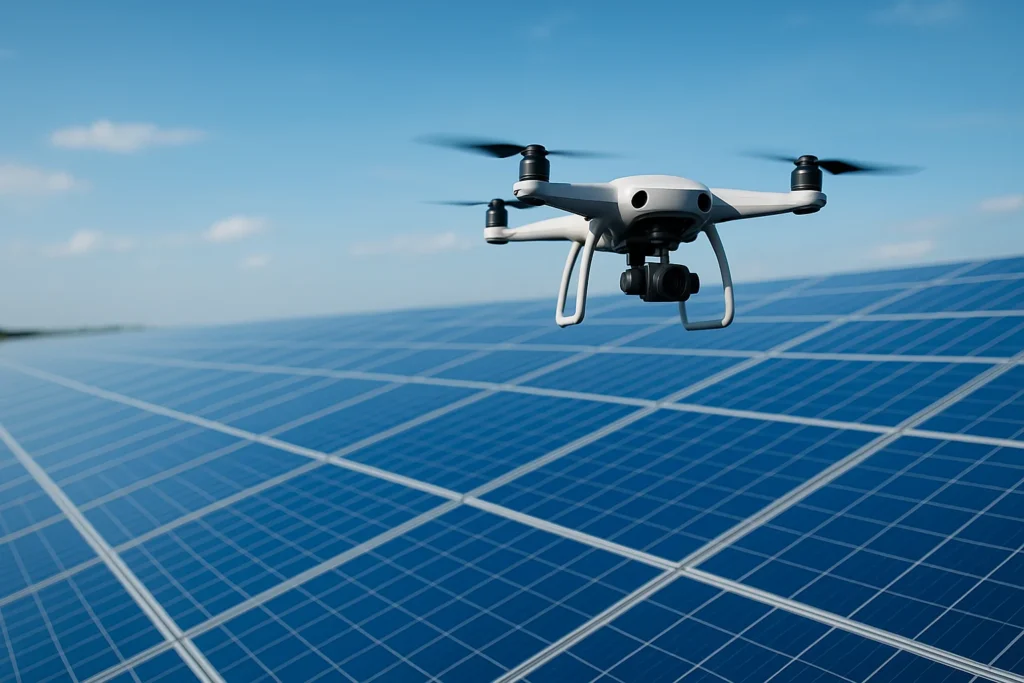
A professional starts with a visual inspection combined with available monitoring data, string comparisons and sometimes thermography to map the impact of pollution solar panel efficiency. That combination reveals where lichen is concentrated, which strings are most affected and whether there is already evidence of hotspots or incipient damage. On that basis, a choice is made between manual brushes, semi-automatic systems or robot-controlled solutions, always using soft, non-abrasive materials.
The choice of water and product is equally important: osmosis or demineralised water is often used, as explained at cleaning solar panels with deionized water, possibly supplemented by a carefully tested bioswelling treatment compatible with the glass and film types used. For industrial roofs or factory sites, where contamination is more complex, lichen solar panel removal additionally requires specific experience with working environments as described at industrial solar panel cleaning. At that stage, safety measures are also determined, including fall protection, accesses and coordination with the site manager.
Step 2: safe execution and monitoring of the result
During execution, the focus is on controlled pressure, even movements and a work sequence that spares panels and cabling. Teams are trained for working at height, know the specific risks of PV installations and respect manufacturers' instructions. Lichen solar panel removal is done in such a way that root structures are loosened rather than sanded away, with sufficient soaking time and rinsing so that residue does not re-form adhesion points.
This is followed by a technical inspection with before-and-after photos, control measurements per string and, where relevant, a targeted general solar panel inspection or additional thermographic inspection. This objectively establishes what yield recovery has been achieved and whether there are any areas of concern for future maintenance. In reports for asset managers, these results link seamlessly with broader programmes for solar panel maintenance, so that lichen solar panel removal is not a stand-alone action, but a reasoned step in the long-term management of the installation.
When is lichen cleaning cost-effective? Dates, planning and cost estimation
The key question for professional owners is not whether lichen looks disruptive, but from when does lichen solar panel removal become financially logical. The answer lies in measurable yield loss solar panel fouling, combined with a realistic assessment of costs and the impact on risks such as hot spots, warranty and future maintenance needs.
Efficiency and payback period of lichen cleaning
For medium to large installations, the business case is built from data: historical yield, comparisons between clean and degraded strings and any measurements from previous inspections. Where contamination levels are high, you often see a clear deviation in production curves, especially at low sun positions when shading by lichen is relatively greater. That difference, complemented by insights from, for example analyses of yield losses due to dirty solar panels, forms the basis for calculating payback.
- Map current efficiency losses through monitoring and string comparisons.
- Make a realistic forecast of yield recovery after lichen cleaning.
- Calculate the total cost of lichen removal, including accessibility and safety.
- Incorporate additional benefits, such as lower risk of hotspots and warranty issues.
- Test the outcome against the remaining lifetime of the installation or roof.
That way, lichen solar panel removal becomes a rational investment, not a reflex based on photos alone. By working with a transparent price cleaning solar panels and clear assumptions about yield recovery, an asset manager can substantiate the decision towards management, investors or ESG reporting without relying on assumptions or gut feeling.
Maintenance planning for business solar panel installations
A one-off action only temporarily solves the problem when the causes persist. Therefore, lichen cleaning should ideally be integrated into a broader data-driven solar panel maintenance programme, focusing on location, roof type, sector and historical pollution levels. Installations at industrial or agricultural sites often require a higher frequency than office roofs, while solar parks along forest edges again show different patterns.
Thoughtful maintenance planning combines lichen solar panel removal with periodic inspections, targeted cleaning of critical areas and timely adjustment of frequency when data suggests it. In doing so, asset managers can use existing knowledge resources such as calculators, cleaning guides and sector articles on Solarco's site to create their own policies that keep both technical risks and long-term costs manageable.
Next step: a thoughtful approach to lichen on your solar panels
A thoughtful approach is essential when lichen becomes visible, especially for owners and operators of medium to large installations. Deciding to remove lichen solar panels without measurement data and the right methods often leads to unnecessary costs or risk of damage, while a structured approach helps to balance efficiency, safety and longevity.
- Inventory and data, yield measurements, thermography and string comparisons determine the actual impact.
- Risk analysis, location, orientation and coating status determine if and when intervention is necessary.
- Method selection with soft brushes, osmosis water and controlled bioswale treatment where technically sound, see also information on deionized water.
Safe execution by certified teams with fall protection and industrial safety protocol, combined with reporting and monitoring with before/after photos and measurement results, ensures that maintenance decisions are well-founded. Always choose a partner that works with measurable criteria and transparent reporting, and for additional background, consult the practical articles within the Expert Tips. Lichen does not require an impulsive choice, but a reasoned intervention that protects efficiency, safety and longevity; if you want to be sure that lichen solar panel removal is done correctly and with measurable benefit, seek advice or an analysis of your installation via Contact.

 Dutch
Dutch  English
  French
  German