
TL;DR
Commercial PV installations rarely fail suddenly. Defects in cables, connectors, fixings and modules build up slowly over 5 to 10 years under thermal, mechanical and chemical stress and remain invisible in standard monitoring for a long time.
- Typical problems: damaged or obsolete cabling and connectors, loose terminals and profiles, microcracks, delamination and hotspots in modules.
- Consequences of not intervening: structural loss of efficiency, recurrent inverter failures, higher fire and safety risk and a shorter economic lifetime.
- Effective approach: data-driven inspections, thermography, targeted electrical measurements, plus cleaning and mechanical checks in a planned maintenance programme.
Treat PV systems as industrial assets with scheduled maintenance, not a passive “black box”. Consider a professional solar panel inspection around year 5-10 or at subtle yield deviations.
As a facility, asset or energy manager of a commercial or industrial PV installation, you want to know quickly what solar panel failures can occur after 5 to 10 years and what impact that has on efficiency, safety and lifespan; this guide highlights the typical solar panel failures in large rooftop and ground-mounted installations, why they are often not visible on delivery, and why a data-driven maintenance approach is necessary instead of ad hoc interventions.
Solar panel failures: why this guide is relevant to you
This guide focuses explicitly on commercial solar panel installations and industrial PV projects, not residential systems, and provides an overview of typical solar panel problems that arise after several years of use in cables, connectors, mountings and modules. The key message is that installations rarely fail suddenly: failures build up gradually, are often visually invisible at first and, without focused data analysis, become noticeable late as loss of efficiency, recurrent failures or shorter technical lifespan, with implications for audits, ESG reporting and insurance claims.
For you as a manager, this means that solar panels should be treated as technical assets that, like HVAC or lifts, require active management, metering and planned maintenance, rather than just attention when faults occur. Typical solar panel failures manifest themselves mainly in cabling, connectors, fixings and modules and require a structured inspection and monitoring strategy, so that small anomalies cannot scale up to safety risks and you can demonstrate maintenance costs to management and insurers; see also our page on solar panel inspection for elaborated inspection methods and reporting formats.
How solar panel failures occur in commercial installations
Aging is normal, failure is not
In any commercial solar panel installation, components age under permanent load, but the real causes solar panel failures rarely lie in a single sudden fault and almost always in years of combination of temperature changes, electrical loads and environmental influences, so solar panel problems do not show up until late in the numbers. A PV installation on a logistics roof, stable or factory hall often runs 365 days a year, which means connectors, cabling, inverters and modules are constantly expanding and contracting, building up small mechanical stresses and sliding step by step closer to failure without you seeing immediate alarms.
From an asset management perspective, a commercial solar panel plant should therefore be treated like any other industrial plant, with planned inspections, measurement rounds and clear maintenance cycles rather than just intervening when an inverter fails or the grid operator calls. Those who actively monitor the ageing pv installation prevent small degradations from accumulating unnoticed into noticeable efficiency losses and defects in cables, connectors or modules, and can plan interventions during quiet periods based on objective data on the installation's condition and performance.
Environmental factors stressing PV components
Commercial PV installations are rarely located in a lab environment, but on flat roofs in logistics, on barn roofs in agriculture or in windy industrial zones, where thermal cycling, moisture and contamination reinforce each other and are thus the main driving force behind how do problems occur with solar panels. On a light metal or bitumen roof, temperature fluctuations between night and full sun can easily reach tens of degrees, causing connectors and terminals to expand and contract again every day, resulting in loose contact, higher transition resistance and thus more heat over time, while UV radiation gradually degrades cable sheathing, plastic housings and seals.
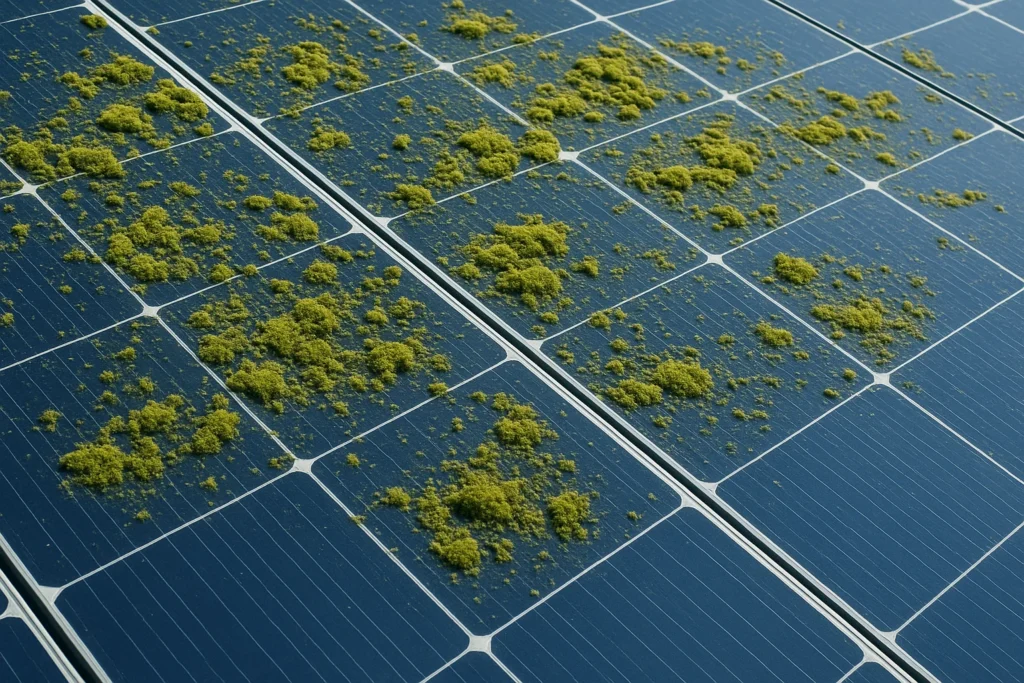
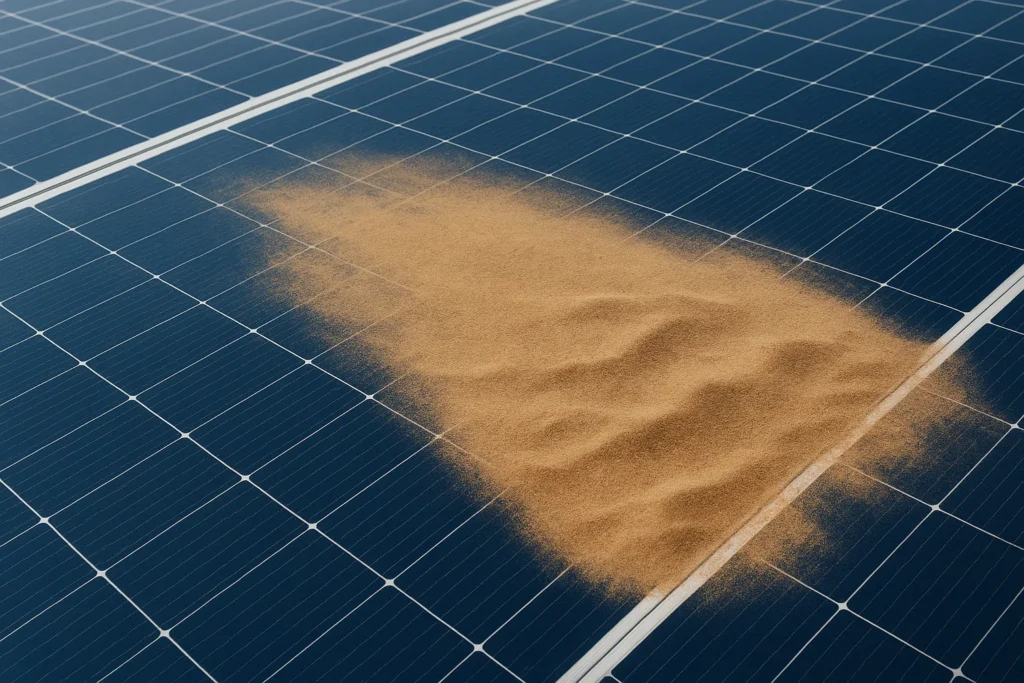
In agricultural and industrial environments, wind loads, turbulence, ammonia, dust, soot and fine sand create additional mechanical and chemical stresses on glass, seals and cabling, causing metal fatigue, micro-movements and minor damage to seals that allow moisture and condensation to enter and ultimately lead to corrosion, insulation failures and breakdowns. Contamination also plays directly into yield and is a major factor behind yield loss due to dirty solar panels, which makes it even more important to look at technical obsolescence and pollution together in an integrated maintenance plan, as we do in our expert tips on maintenance and inspection explain.
Common solar panel failures after 5 to 10 years
Cabling and connectors: typical defects
After five to 10 years of use, we see recurring patterns in cable and connector problems in many commercial installations, which are at the root of many of the typical problems solar panels face on commercial rooftops and solar farms. Cabling that was neatly strung up upon completion can gradually sag due to wind and thermal movement, causing cables to rub over sharp eaves or support structures and damaging the insulation bit by bit, leading over time to insulation failures or earth leakage problems, while exposed DC cables that are not or insufficiently UV-resistant dry out and crackle, allowing dirt and water to enter.
For connectors, poor or ageing crimped connections and incompatible combinations are particularly noticeable, for example when different types of connectors have been used over the years or non-original parts have been inserted during extensions or repairs. A badly crimped contact, a connector that is not fully inserted or moisture ingress via damaged seals increases the transition resistance, causes a lot of heat locally on sunny days and makes fire danger connector solar panels real, even if the inverter does not yet show a clear fault code, so that detecting a defective solar panel always also means systematically measuring entire cable routes and string connections.
Fixings, support structure and modules
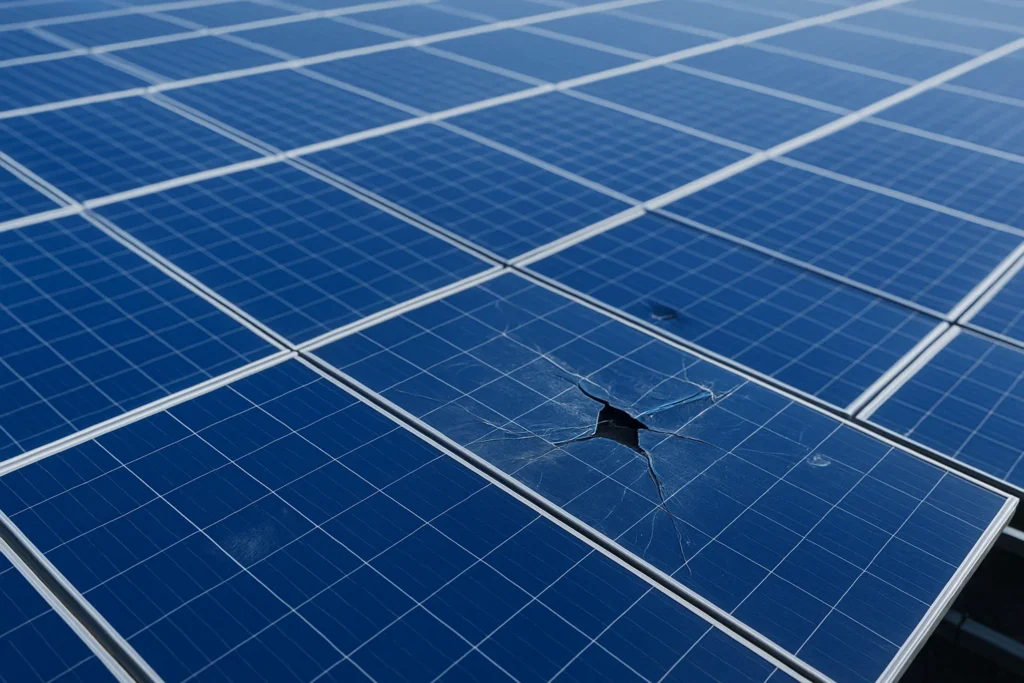
The support structure and fixings of a commercial PV installation are subjected to years of wind load and thermal stresses, which means that clamps slowly lose their tensile strength, bolts may loosen slightly and some panels move more than anticipated, with microcracks in cells and glass as a creeping consequence. Metal fatigue in long profile rails or sub-structures on flat roofs can cause small deformations, causing ballast to shift or rows to shift slightly, translating into leakage risks or irregular mechanical loading per module only years later, and in severe weather conditions, this can culminate in a glass solar panel failure due to a combination of long-term fatigue and a final peak load.
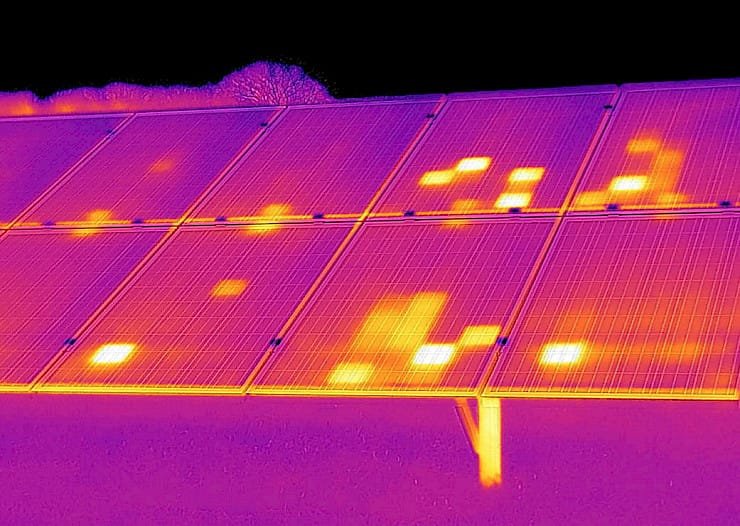
In modules themselves, we regularly see incipient delamination after 5 to 10 years, where the layers of the panel no longer adhere perfectly everywhere, and microcracks that initially had no visible effect develop into real hotspots with locally strong heating and accelerated degradation. Because many of these defects are hardly recognisable visually, measurement campaigns and thermographic inspections of commercial fields provide much more information than a quick tour with the naked eye, especially in large roofs or solar parks, and by findings from a hotspot scan of solar panels linking to a targeted general solar panel inspection, a clear picture emerges of where most of the risks and return losses are.
Typical defects after 5-10 years and their impact
Commercial PV installations rarely fail suddenly. The matrix below shows where problems typically arise, how visible they are, what the effect is if you do nothing, and what inspection method you need.
| Component | Typical defects (5-10 years) | Visible by eye? | Consequence without intervention | Detection / approach |
|---|---|---|---|---|
| DC wiring cable routes |
|
Sometimes (in case of mantle damage) |
Medium Insulation faults, earth faults, intermittent string failures |
Visual check + cable routing check, insulation resistance measurement, targeted repair/conductivity |
| Connectors DC connections |
|
Rarely |
High Transition resistance → heat → yield loss & fire risk |
Thermography under load + targeted electrical measurements; replace/document suspect connectors |
| Attachments clamps/rails |
|
Sometimes (with obvious movement) |
Medium Additional mechanical stress → microcracks, leakage risk, storm damage |
Mechanical inspection (terminals, rails, ballast), check for movement/tension, tighten/adjust |
| Modules panels |
|
No (in early stages) |
High Structural efficiency loss, accelerated degradation, local overheating |
Clean first; then thermography + (selective) IV measurements; string analysis to locate underperformers |
| Inverter & logs symptom carrier |
|
No (mostly via dates) |
Medium Downtime, loss at peak times, fault diagnoses without root-cause |
Log analysis + string comparison; combine with IR/measurements to confirm cause (connector/cable/module) |
Why solar panel defects often remain invisible for a long time
In the first few years after completion, a commercial PV installation often appears to run smoothly, as monitoring portals show no hard faults, the inverters log no conspicuous fault codes, and visual checks at inspection or tour show few anomalies, leading one to quickly conclude that there are no relevant defects solar panels present. In reality, many faults start as minute deviations in current or voltage of a string, which in a total installation of several hundred kilowatts to several megawatts are barely noticeable in the daily curve, especially when no one systematically looks at deviations of a few percent per string.
Even incidents such as a brief solar inverter failure, a one-off Fluvius power outage solar panels or an occasional deviation in daily yield are often dismissed as grid fluctuations or software bugs, while in some cases they are the first signal of incipient connector problems, insulation weakening or a module that is structurally underperforming. Because inverters are designed to keep a system running for as long as possible and alarm solar panels often go off only when a string fails completely or insulation resistance drops below a critical limit, underlying problems often go undetected for years and the question of how do I know if a solar panel is broken can only be reliably answered in a commercial context through active data analysis over longer periods and targeted additional inspections.
Consequences of not intervening in solar panel problems
When incipient failures of solar panels remain for years, they almost always result in structural loss of efficiency, recurring failures and a shorter technical lifespan of the installation, even if no spectacular incidents occur in the short term. A string with one or more weak modules or a bad connector delivers less power, causing the entire string to underperform and the inverter to adjust its operating point, resulting in you silently losing kWh every year that can never be made up, whereas the business case was based on nominal yield over 20 to 25 years.
In practice, unexplained inverter failures, where an inverter repeatedly switches itself off or fails to switch back on after a Fluvius power failure solar panels, often turn out to be caused by underlying cable or connector problems, an inverter failure due to defective panel or insulation faults in outdated cabling. Those wishing to realistically assess the impact of solar panel failures therefore look not only at the immediate repair cost, but also at lifetime yield losses, the increased risk profile of the site and the impact on financial reporting, with tools such as the efficiency loss calculator for dirty solar panels can give an initial indication of what seemingly small deviations cost in the long run.
Detecting faulty solar panels: from complaint to diagnosis
Signs that a solar panel is faulty
In professional installations, the process of detecting a faulty solar array often starts with a subtle signal, such as a small deviation in the monitoring graph, a difference between strings in one field or an unexplained performance gap between comparable sites, rather than with a completely failed installation. Operators or energy managers notice, for example, that one inverter systematically produces less energy than comparable inverters on the same roof, or that a specific string regularly fails at peak times, which is quickly labelled in reports as temporary solar inverter failure.
Reports from the grid operator, for example after a Fluvius power outage solar panels or voltage problems in the neighbourhood, can also be reason to look deeper, because such events put extra strain on weak spots in connectors, cabling or inverters and make existing problems visible more quickly. In some cases, action is only taken when an inspector comments on insulation values, or when someone physically notices that 1 solar panel is not working in an otherwise homogeneous field, but that is in fact a late stage in fault development, where already existing faulty solar panels have already developed into obvious performance or safety problems.
Inspection methods for professional PV installations
Once the suspected problem area is delineated, the step of targeted inspection follows, with various measurement and monitoring methods complementing each other to provide reliable diagnoses in large commercial systems. A thorough visual inspection of cable runs, connectors, fasteners and junction boxes quickly yields clues about damaged insulation, loose plugs, burnt contacts or moisture traces, especially when carried out by technicians who know what common defects solar panels look like in the field, while string measurements and insulation resistance measurements reveal whether there are anomalies in current, voltage or leakage currents compared to healthy reference strings.
For an in-depth picture of the performance of individual modules, IV curves can be used, which reveal deviations in series resistance, bypass diodes or cell behaviour, although these are mainly used for critical or difficult to explain failures. Thermography solar panels is thereby a powerful method to detect hotspots, bad contacts and internal module defects under load, as temperature differences are often more visible than electrical abnormalities at string level, and by combining these techniques in a periodic thermographic solar panel inspection with accompanying reporting creates a robust basis for targeted replacement of defective components and prevention of future problems.
Preventive maintenance to avoid solar panel failures
Combination of cleaning, mechanical control and measurements
Preventive maintenance on commercial PV installations is not about scheduling as many interventions as possible every year, but rather about detecting and remedying solar panel defects through targeted actions well before they lead to failures, yield losses or safety incidents. A well-thought-out maintenance plan therefore combines professional cleaning, mechanical inspection of support structures and terminals plus targeted electrical measurements and thermographic scans, tailored to the specific risks of your site and the ageing phase of the installation, so that contamination and wear and tear cannot develop into critical failures unnoticed.
Cleaning not only removes contamination that directly causes efficiency losses due to soiled solar panels, but also allows technicians to closely inspect the surface and surrounding area for cracks, delamination, discolouration and loose parts, while mechanical checks verify the condition of rails, clamps, ballast, roof penetrations and cable routing, and electrical measurements at string and field level reveal abnormalities in current, voltage and insulation resistance at an early stage. By combining these building blocks into one integrated programme for solar panel maintenance with structured reporting, you have substantiated information for warranties, audits and future comparisons, rather than isolated findings with no history.
From firefighting to manageable asset management
For many organisations, PV installation maintenance still feels like fire-fighting, acting only when there is a clear failure, complaint or safety issue, whereas most solar panel failures were detectable years earlier with relatively limited efforts. By switching to an asset management approach, in which performance indicators, inspection results and maintenance actions are systematically monitored, the installation becomes a manageable asset instead of a black box on the roof, and sites with heavier loads, such as barns with a lot of ammonia or roofs in industrial environments, can be given higher priority in a targeted way.
Data-driven inspection makes it possible to compare installations, adjust maintenance frequencies based on actual ageing and critically test assumptions such as rain is enough to keep panels clean against real-world data and case studies, as described on our page on professional solar panel cleaning. Those who make this shift will see that preventive maintenance is not about doing more, but about smarter planning and underpinning in a multi-year plan in which inspections, cleanings and possible replacements follow logically from one another, so that defective solar panels are detected earlier, the total cost of ownership is reduced and the long-term efficiency of the installation remains better protected.
When does a professional inspection of your solar panels make sense?
- 5-10 years after completion, the time when ageing of cables, connectors and fixings becomes more visible or measurable.
- For subtle but persistent anomalies in monitoring, such as a gradual yield drop per string or recurrent inverter failures.
- On alarm signals from the inverter, reports from the grid operator or after a Fluvius power failure.
- After major roof or electrical works, or when there is visible mechanical damage or glass breakage.
- For audits, insurance files or ESG reports, when demonstrable inspection and measurement data are required.
A professional inspection combines visual inspection, thermography and targeted electrical measurements to detect latent solar panel failures early, before they lead to yield losses, unexplained failures or safety risks, and is a cost-effective way for medium and large commercial installations to manage long-term efficiency and liability. See our standardised inspections and thermographic options on the page about solar panel inspection for more details and opportunities to fit this into your maintenance strategy.
In summary, defects often build up slowly and remain invisible for a long time, so preventive inspections and data-driven maintenance immediately protect efficiency, safety and longevity and prevent small anomalies from turning into major incidents. If you want security for your commercial installation and have defects solar panels detected and quantified early, contact us for discreet advice and a customised inspection and maintenance plan via Contact Solarco.
FAQ
When should I schedule a professional inspection for my commercial PV plant?
Schedule an inspection especially around 5-10 years after completion, in case of persistent or subtle yield drops per string, after alarm signals from inverters or the grid operator, or after roof or electrical work. For options and standard packages see solar panel inspection.
Which defects are most common after 5-10 years?
The most common problems are obsolete or damaged cabling and connectors, loosened fasteners, metal fatigue in support structures, microcracks and incipient delamination in modules.
How do I recognise that yield loss is not just due to pollution?
Compare strings and fields in monitoring: structural differences between similar inverters or strings, recurring peak faults or insulation values that deviate indicate electrical or mechanical problems in addition to contamination. A combination of cleaning and targeted measurement campaigns reveals the cause.
Can an inverter fail recurrently due to faulty panels or connectors?
Yes. Bad connectors, insulation faults or faulty modules can cause voltage or leakage current problems that cause inverters to shut down or reboot, even if the inverter itself has no internal fault.
What does a thermographic inspection solve?
Thermography detects hot spots, loose contacts and bad connections that become locally hot under load. It is particularly useful for revealing faulty modules and connectors before they fail electrically; read more about our approach at thermographic solar panel inspection.
How often should commercial plants be cleaned?
Cleaning frequency depends on location (dust, ammonia, soot), slope angle and yield loss. Use site-specific inspections and yield analysis to determine a maintenance interval; in many cases, once to twice a year is sufficient, more intensive in case of agricultural or industrial pollution.
Is fire risk a real risk with obsolete connectors?
Yes. Increased transition resistance due to poor contact or corroding connections can generate a lot of heat locally and increase fire risk. Systematic inspection and replacement of suspect connectors significantly reduce that risk.
Do small undetected defects lead to a much shorter lifespan?
Yes. Small defects such as microcracks or leaking junction boxes worsen and cause permanent loss of efficiency and accelerated degradation, which can shorten the economic life of the installation. Tools such as the yield loss calculator help quantify the impact.
What belongs at least in a professional maintenance and inspection plan?
A complete plan combines visual checks, mechanical inspection of fixings and support structure, cleaning, electrical measurements per string and periodic thermographic scans. Data-driven reporting with historical metrics is crucial to prioritise interventions; see solar panel maintenance For examples.


 Dutch
Dutch  English
  French
  German