
TL;DR
Professional solar panel maintenance is about continuous efficiency, safety and compliance, not a loose cleaning round. Most problems arise below the surface and are only visible through measurements and monitoring.
- Always combine cleaning with mechanical and electrical inspections, thermography, IV measurements and string analysis, preferably through a structural solar panel maintenance contract.
- Losses due to microcracks, hotspots, connector problems, PID and contamination are often invisible, but directly cost revenue and can cause fire risk.
- Clean first, then inspect, so that IR images and measurements are reliable and real defects surface.
- Tune frequency and depth of maintenance to environment, scale, criticality and monitoring data, not fixed rules of thumb.
- Engage a specialist in case of unexplained yield losses, failures or ESG and insurance liabilities so that reporting and asset strategy rest on facts.
Solar panel maintenance for medium and large B2B installations is not an occasional cleaning job but a continuous, technically based approach; a visual inspection only shows what is already visibly going wrong, while most efficiency losses and electrical faults develop below the surface and only become visible under load or through measurements.
Solar panel maintenance for professional installations: core proposition and context
For professional installations, solar panel maintenance means a combination of periodic cleaning, mechanical and electrical checks, performance monitoring and inspection reporting, aligned with asset and risk management. It includes more than cleaning: thermographic checks, IV measurements and cabling inspection are standard components of solar panel service and maintenance. For practical examples of inspections, see our page on solar panel inspection.
Key statement: most problems arise below the surface
In short: visual checks give a first impression, but functional and electrical problems such as microcracks, incipient hotspots or increased transition resistance only manifest themselves under load or through instrumental measurements; maintenance must therefore be data-driven and not gut-feeling. Facility and asset managers need to see maintenance as part of efficiency, safety and ESG accountability rather than as a separate service.
- Yield: invisible defects reduce yield without visual cues.
- Safety: connector and cabling faults can pose a fire risk despite a clean appearance.
- Operational management and ESG: solar panel review should combine measurement data and trend analysis with professional solar panel cleaning to support audits and asset management.
Therefore, professional maintenance should not rely on occasional tours or drone footage alone; a good maintenance contract pairs visual checks with thermography, electrical measurements and continuous monitoring so that decisions for service and maintenance solar panels are evidence-based, reproducible and suitable for asset management.

What does professional solar panel maintenance involve?
Professional solar panel maintenance involves a planned combination of cleaning, inspection, measurement and reporting, not an isolated cleaning round. For medium and large roofs or solar parks, it is part of asset management, similar to maintaining your HVAC, production lines or high-voltage. A structural approach via a solar panel maintenance contract ensures that profitability, safety and compliance remain predictable rather than being followed up ad hoc, and is in line with the broader framework of general maintenance of solar panels.
Main maintenance steps
The core of service and maintenance solar panels consists of a number of recurring steps that together cover the technical behaviour of the installation. Besides professional cleaning, inverters, strings, connectors, support structures and protection components are checked under load, complemented by measurements and trend analysis.
- Professional cleaning of panels and construction tailored to roof type, slope and water drainage.
- Mechanical check of support structure, clamps, ballast, wind anchors and seals.
- Electrical inspection and maintenance solar inverter, including measurements, log analysis and production control with clear reporting.
This provides a realistic picture of the actual condition of the system, rather than just what the eye happens to notice during a tour. This is why professional parties link cleaning to inspection and performance analysis as standard, so that solar panel maintenance demonstrably contributes to efficiency and lifespan rather than just giving optical results.
Difference between residential and professional maintenance
For private roofs, a global check is often sufficient for years, as long as the installation is small and the risk profile limited. With commercial roofs, logistics sites or solar parks, however, the financial impact of yield losses and downtime is much greater, as are the requirements around safety and ESG reporting.
There, solar panel maintenance is mandatory to substantiate internal and external audits, whether for insurers, financiers or sustainability certifications. Furthermore, scale makes all the difference: a deviation of a few percent on an industrial plant immediately translates into thousands of euros, so professional maintenance focuses on yield predictability, understanding degradation and avoiding technical incidents.
Why a visual inspection in solar panel maintenance is not enough
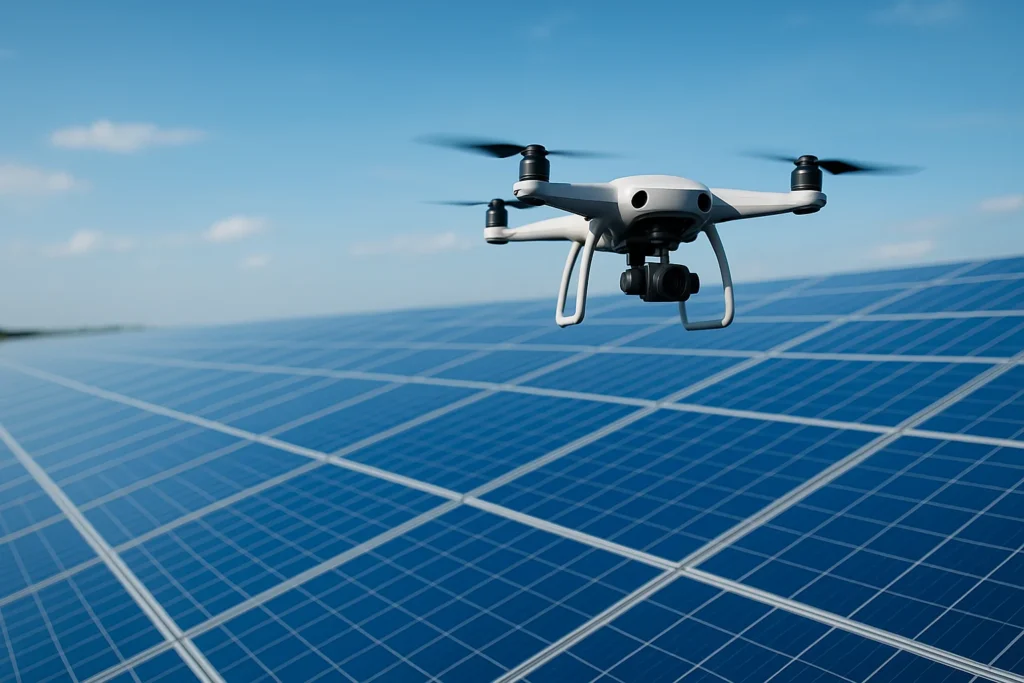
A visual inspection seems efficient at first glance: someone walks onto the roof, checks panels and wiring, or drone footage is taken. For professional solar panel maintenance, this is a useful first layer, but no more than that.
What a visual inspection does show
Visual checks and drone images are ideally suited to spot major and gross problems. Think heavy pollution, broken glass after a storm, loose wiring or obviously shifted modules.
- Visible contamination from dust, bird droppings, leaves or agricultural residue.
- Visible glass breakage or impact damage of objects.
- Loose or mechanically damaged cables and connectors.
Late-stage problems such as heavily discoloured modules or obvious delamination are also relatively quickly noticed during a basic solar panel inspection. This visual layer therefore remains important, but tells little about incipient technical defects or subtle yield losses, which is why in professional environments a visual inspection is combined with techniques such as thermographic inspection solar panels or IR inspection solar panels.
What a visual inspection does not reveal
There is a world going on under the glass and in the connections that no camera can directly see. Microcracks in cells, incipient hotspots, increased transition resistance in connectors or the first stages of PID degradation change electrical behaviour, but not immediate appearance.
This is precisely why quick tours or drone flights do not suffice as a complete assessment of a plant's health. Data-driven solar panel maintenance combines visual observations with production data, string analyses and targeted thermographic measurements, for example via a specialised thermographic solar panel inspection, so that functional defects are detected before they become visible.
Overview: when is visual inspection enough - and when do you call in an expert?
Use this as a practical decision tree. In B2B context, “it looks OK” is rarely enough when efficiency, safety or compliance come into play.
| Situation / trigger | Visual inspection is sufficient if... | Call in an expert if... | Why (briefly) |
|---|---|---|---|
|
Routine check No complaints, no alarms |
Sufficient
|
Check dates
|
Visual is a screening. Without data, you miss incipient defects and degradation. |
|
Pollution Dust, bird droppings, agriculture/industry |
Restricted
|
Expert
|
Uneven contamination causes hotspots and distorts thermography/measurements. |
|
Storm/damage event Hail, wind, falling objects |
Screening first
|
Expert
|
Event damage can cause microcracks/connector problems with no immediately visible trace. |
|
Unexplained loss of efficiency Deviation from baseline/expectation |
Rarely
|
Always
|
Efficiency loss is often electrical/functional and only visible under load or with measurements. |
|
Inverter faults / derating Error codes, temperature limits |
Not enough
|
Expert
|
Causes are often in strings, transition resistance, temperature or components - not in what you see. |
|
ESG / audit / insurance Reporting requirement or risk assessment |
No
|
Yes
|
Compliance requires demonstrability: measurement data + methodology + documentation. |
Technical problems you don't see but cost you revenue
Many installations look neat from the roof, while monitoring meanwhile shows structural efficiency losses. The main causes are then not dirt or visible damage, but invisible electrical and mechanical abnormalities in cells, connections and insulation.
Microcracks, cell defects and hotspots in early stages
Microcracks often already occur during transport, assembly or through repeated wind and temperature cycles, and in many cases remain completely invisible for a long time. In the first few months, the system still delivers neat power, while certain cells or cell strips are already participating less electrically.
The effect is accelerated yield loss, local warming and in some cases the development of hotspots that only later lead to visible discolouration or fire damage. Hotspots at an early stage manifest themselves mainly as slight temperature anomalies that can only be seen via thermography or accurate measurements, making a panel appear optically healthy but already technically deteriorating.
Connector problems, PID and other electrical anomalies
Connector and cabling problems are among the most underestimated sources of risk in large PV installations. Poor crimp connections, incompatible connector combinations or moisture in couplings often look neat on the outside, but cause increased transition resistance.
This leads to unnecessary heat generation, additional efficiency loss and, in the worst case, smouldering or fire hazard at the level of a coupler or junction box. In addition, voltage-related phenomena such as PID can cause uniform loss over several panels with no visible trace, where production data and a targeted scan of hotspots on solar panels are needed to safely detect such anomalies.
Contamination, cleaning and reliable inspection of solar panels
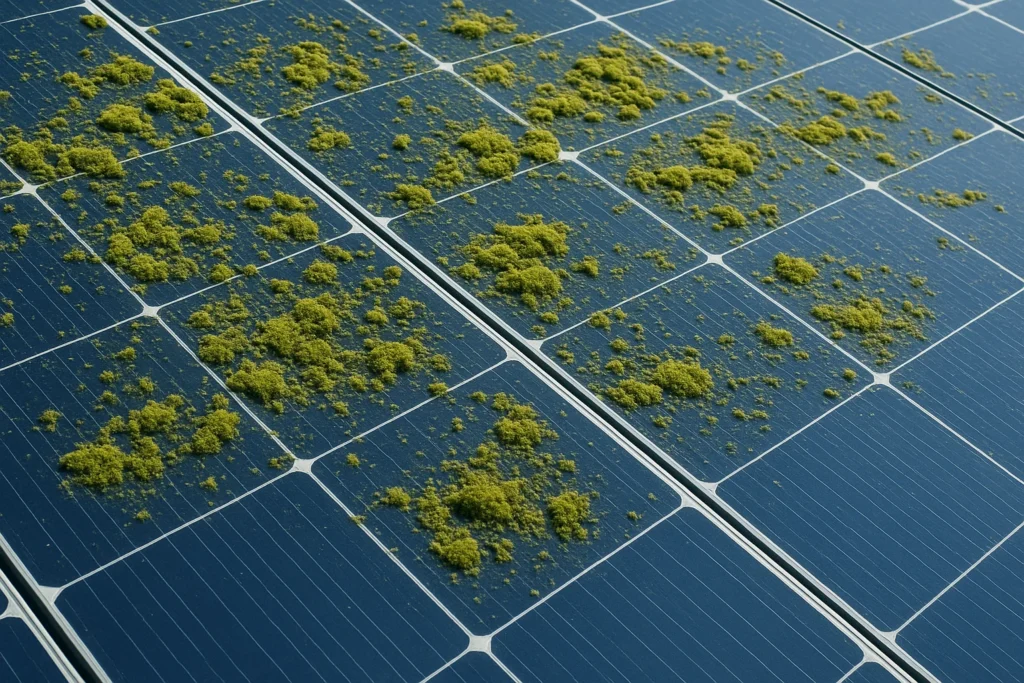
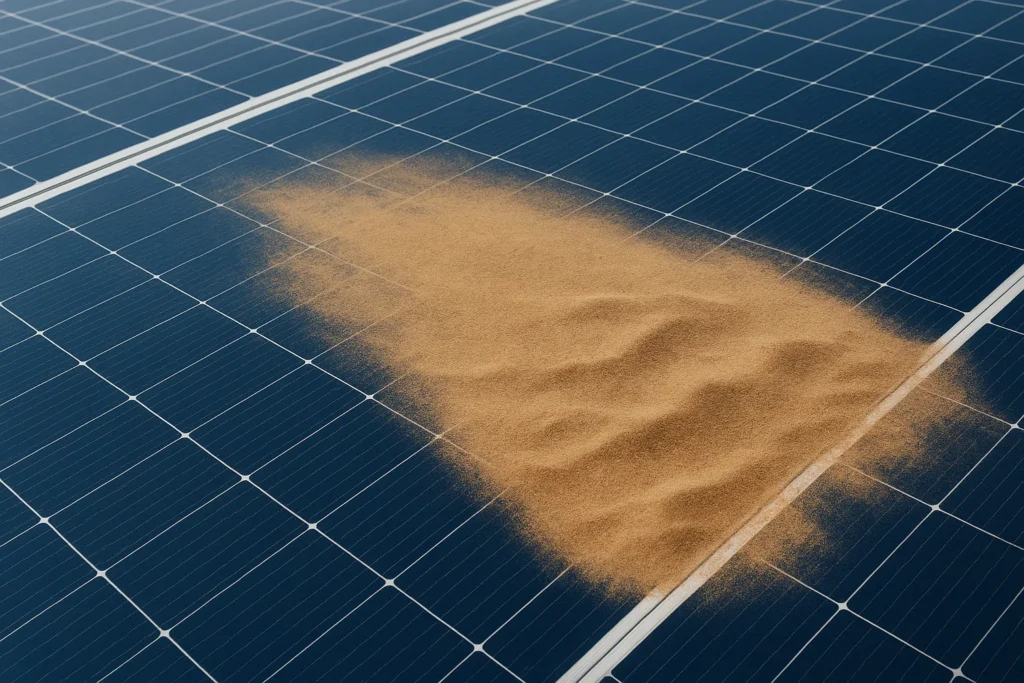
At first glance, contamination on solar modules seems only an aesthetic problem, but it directly affects light incidence, temperature distribution and module ageing. On logistic roofs, industrial sites or farms, dust, bird droppings, pollen, ammonia residue and soot accumulate much faster than on a conventional house, making professional cleaning an integral part of solar panel maintenance.
Effect of pollution on efficiency and safety
Irregular pollution creates shadow spots that make some cells work harder than others, resulting in localised heating and micro-hotspots. This translates into measurable yield loss, as well as additional thermal stress that causes panels to degrade faster.
On large roofs or solar farms, a small percentage loss due to contamination quickly makes a financially noticeable difference, especially when contamination is concentrated around specific areas such as eaves or vents. Understanding the solar panel cleaning price helps to weigh these losses against maintenance costs and choose an appropriate cleaning regime.
Why cleaning is a prerequisite for correct inspection
Inspections on dirty panels often produce misleading images. Dirt can actually hide existing hotspots, while uneven dirt creates sham problems on thermographic images because temperature differences mainly show the dirt patterns.
Therefore, in data-driven solar panel maintenance, cleaning is explicitly scheduled before measurements and thermographic scans. With clean surfaces, IR images, IV measurements and string comparisons are a lot more reliable and show the plant's true behaviour, especially when a professional partner for cleaning of solar panels works with safe, certified methods.
How often and in what way do you perform solar panel maintenance?
Questions such as how often you should maintain solar panels or whether you can clean them yourself have no single answer in a B2B context. The right frequency depends on environment, mounting method, slope, accessibility and the criticality of the installation to your operations.
Frequency and scheduling of maintenance
At industrial or logistics sites with high levels of dust, traffic or smoke, bi-annual or sometimes annual cleaning is often appropriate, especially when monitoring shows demonstrable loss of efficiency due to contamination. Agricultural roofs with ammonia, dust or bird droppings usually require higher maintenance frequency than offices in green surroundings.
The method of installation also plays a role: flat roofs with small angles of inclination hold more dirt and standing water than highly inclined systems or ground installations. A combination of production analysis and targeted inspections reveals when contamination or technical deviations reach the threshold at which intervention becomes economically sensible, with a yield loss calculator or guidelines on how often to clean solar panels provide additional handholding.
Do it yourself or outsource solar panel maintenance
Some of the work can be done internally, as long as safety and technical limits are respected. Consider simple visual checks from the ground or via safe walkways, signalling glaring alarms from monitoring or reporting damage after a storm.
As soon as there is work at height, electrical measurements, solar panel inverter maintenance or interventions on cabling and connectors, a specialised party is necessary to guarantee both safety and quality. For larger installations and situations with multiple owners or tenants, such as maintenance solar panels tenant or landlord, a professional solar panel maintenance contract provides clarity on roles, responsibilities and reporting.
Data-driven solar panel maintenance: measurements, monitoring and reporting
In data-driven solar panel maintenance, numbers determine when and where you intervene. Instead of fixed schedules or gut feeling, production curves, string comparisons, thermographic images and electrical measurements form the basis for decisions.
Monitoring and measurements as a basis for decisions
A well-designed monitoring system continuously records the yield per inverter or string and compares it with expectations based on irradiance, temperature and design. Deviations thus become visible early, for example when a string lags structurally or an inverter regularly derates due to temperature.
These insights are the starting point for targeted inspections and measurements rather than generic checks across the entire installation. On top of that, periodic measurements such as thermographic inspection of solar panels, insulation tests or IV measurements at representative parts of the farm, which will better relate maintenance costs to efficiency effects.
Reporting, audits and long-term strategy
For many companies, ESG reports, internal audits and investor requirements play an increasing role in decisions around solar panels. Transparent maintenance reports with photos, measurement results, thermal images and clear recommendations reveal what is happening with that installation and what risks have been eliminated.
This makes it easier to get budgets for service and maintenance solar panels approved and to base discussions about maintenance costs versus yield loss on facts. At the portfolio level, a data-driven approach helps prioritise between different sites and installations, so that solar panel maintenance is structurally integrated into energy and asset strategy.
When do you hire a specialist for solar panel maintenance?
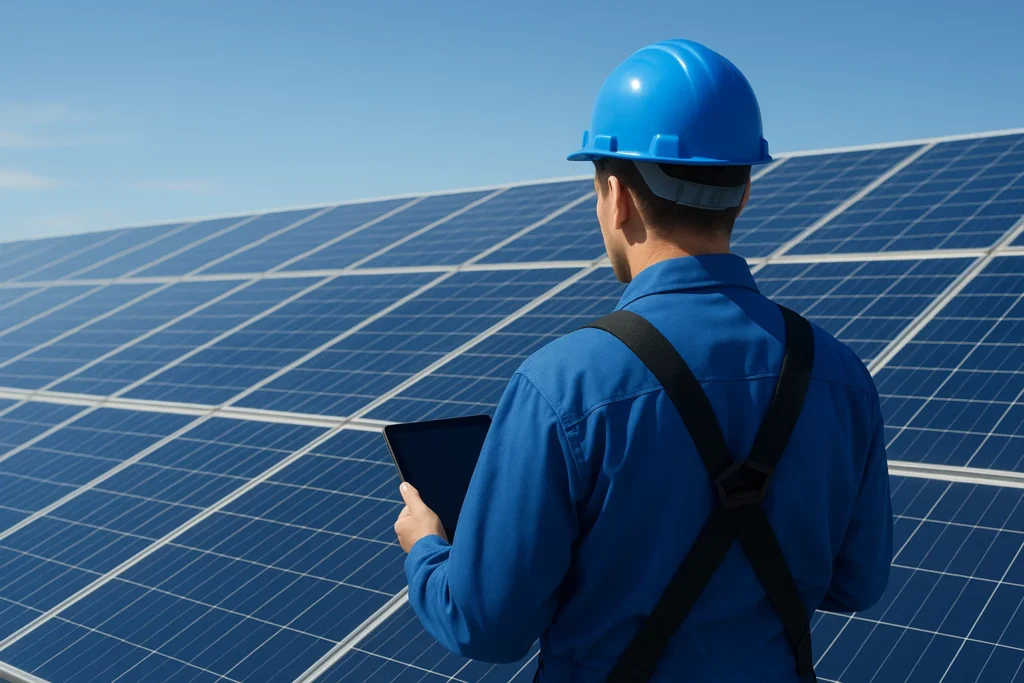
With professional installations, the decision is not purely technical, but strategic: call in a specialist as soon as efficiency, safety or compliance are at stake. A data-driven partner prevents hidden defects and incorrect assumptions from affecting your asset value and ensures that service and maintenance solar panels demonstrably contribute to continuity.
- Noticeable and persistent loss of efficiency not explained by weather data.
- Repeated inverter failures, string failures or unexplained voltage anomalies.
- ESG audits, warranty claims or when you need demonstrable reporting for stakeholders.
In all these cases, a combination of professional solar panel cleaning, thermography and targeted electrical measurements is preferable to a simple visual check, as this is the only way to address functional problems early and cost-effectively. In summary, treat solar panel maintenance as a strategic investment: with data-driven inspections and professional cleaning, you protect efficiency and safety, and if you would like to discuss your installation's situation, please contact us via the contact page contact Solarco.
FAQ
Why is a visual inspection not sufficient for professional PV installations?
Visual inspections only show surface problems; many efficiency losses and safety hazards occur under the glass or in connectors and are only detectable with thermography, IV measurements, string analysis or monitoring data.
How often should solar panels on industrial roofs be cleaned?
This varies by site: sites with high levels of dust, traffic or ammonia may require annual or biennial cleaning, while quieter sites may require less frequent cleaning; combine cleaning frequency with monitoring results and advice from practice guidelines.
When is it better to call in a specialist?
Engage a specialist in case of persistent and unexplained yield losses, repeated inverter failures, suspicious temperature patterns in thermography or when you are required to provide demonstrable reporting for insurers, financiers or ESG audits -. safety and compliance weigh heavily here.
What is a thermographic inspection and why is it important?
Thermography detects temperature anomalies that indicate hotspots, bad connections or faulty cells. It is a quick way to detect electrical-related problems at an early stage and prevents subtle defects from causing major yield losses or fire hazards later on. See also our page on thermographic solar panel inspection.
Should cleaning and inspection always be combined?
Yes: Cleaning before measurements and thermographic scans is essential because dirt can distort IR images and IV measurements. With clean panels, thermal and electrical measurements are more reliable and give a more realistic picture of installation performance.
What belongs at least in a professional maintenance contract?
A good contract includes periodic professional cleaning, mechanical checks of support structure, electrical inspections including IV or insulation tests, thermography, continuous monitoring and clear reporting with recommendations and roles/responsibilities; making maintenance demonstrable and suitable for asset and ESG management. See solar panel maintenance contract For examples.


 Dutch
Dutch  English
  French
  German