
TL;DR
For medium and large PV plants, sahara sand is usually not an acute risk, but it can affect structural efficiency and safety margins. This article provides a framework to plan cleaning after dust events not reflexively, but data-driven and economically based.
- Monitoring data often show 2 to 5 per cent power loss, with heavier or uneven contamination more, with additional risk of hot spots and accelerated degradation.
- Clean only after analysis of production curves, visual inspection and factors such as slope angle, environment and rainfall forecast, not with garden hose, high pressure or aggressive agents.
- Deploy professional, low-pressure cleaning with osmosis water and robots within a broader maintenance plan, as described at how to clean solar panels.
- Establish objective thresholds and procedures, combine with periodic inspections and thermography so that any intervention remains technically and financially defensible.
When sahara sand covers solar panels after southern dust transports, facility and asset managers want to know quickly whether it harms yield, safety or lifespan. Instead of reflexively cleaning, this article describes how to rationally decide what to do for medium and large facilities and when professional cleaning makes sense.
Sahara sand on solar panels: what do you need to know?
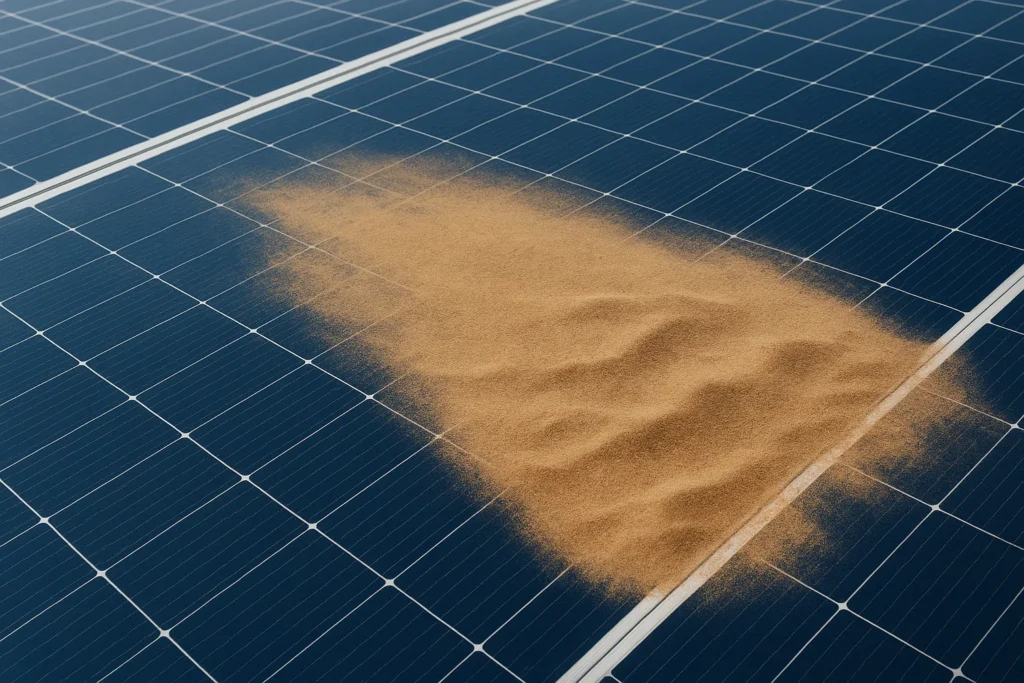
In certain weather patterns, fine dust from southern areas can accumulate on panels in Belgium, the Netherlands and northern France, visible as a light brown haze or spots on glass and frames. For professional installations, this is relevant because sahara sand on solar panels behaves differently from ordinary localised contamination, and accumulation along edges, in frames or on underlying structures can mask yields more effectively than on individual panels.
Short and to the point: sahara sand on solar panels is rarely directly destructive, but affects solar panels through additional reflection, scattering and local accumulation, and can cause invisible yield loss if left on. Solarco filters media hype and relies on monitoring data: in commercial and industrial systems, we see measurable dips after dust events, but the right response is not a reflexive cleaning, it is a focused inspection and data-driven decision that monitors safety and cost-efficiency; for more context on when cleaning makes sense or not, see also our analysis of why solar panel cleaning nonsense can be too absolute.
Impact of sahara sand on solar panel efficiency and safety
A thin layer of dust seems harmless, but monitoring data show that sahara sand can noticeably squeeze solar panels in a short time, especially in large roof fields and solar farms. A film of fine sand causes extra reflection and scattering of light, so less radiation reaches the cells and you face invisible yield loss that is not noticeable in SCADA or portal until you compare properly. With light contamination, we often see 2 to 5 per cent direct power loss, with thicker and unevenly distributed layers this can rise towards 8 to 10 per cent or more on certain strings, which for a 500 kWp installation quickly adds up to hundreds of euros per year in missed yield. Those who want to know how much efficiency loss solar panels due to pollution mean in their situation can make it concrete with their own production analysis or with tools such as the yield loss calculator and the insights from efficiency loss due to pollution.
- A homogeneous film of sahara sand on solar panels provides additional reflection at the glass surface so that less light penetrates.
- Accumulation along the bottom edge or in frame profiles creates local shadows that put greater stress on certain cells.
- When combined with pollen, agricultural dust or urban soot, sahara sand forms a stubborn crust that rain does not wash away.
That localised and uneven dirt pattern is particularly relevant to safety and longevity, as it increases the likelihood of hotspots on solar panels increases and thus causes additional thermal stress. Cells or partial cells that are partially covered more often run structurally hotter, which can accelerate degradation, solder breaks or insulation faults towards frame and cabling. In practice, Solarco links monitoring data, string comparisons and sometimes thermographic inspections to make the effect of sahara sand on efficiency and safety measurable and distinguish between cosmetic contamination and real risk areas, also taking into account orientation and slope angle.
Cleaning Sahara sand solar panels: what to do and what not to do
After a dust event, many managers instinctively want to start cleaning immediately, but with large roofs and solar farms, sahara sand solar panel cleaning must first pass the yardstick of safety, water quality and cost-benefit. It is not about a bucket of water and a brush, but coordinated interventions at height, often with robots and osmosis water, that restore efficiency without damaging glass, seals or cabling.
1. Step-by-step cleaning after a sahara sand event
For professional owners, a sensible approach starts with a brief analysis rather than immediately sending a crew onto the roof. First, look at monitoring data around the dust point and compare daily curves with clean reference periods so that it is clear whether sahara sand solar panels are actually causing a significant dip. Combine that with a visual inspection by installation type roof, carport, ground setup to estimate where sand is accumulating and whether additional contamination such as fertiliser, industrial dust or leaves are at play. Only then does it make sense to schedule cleaning, ideally with osmosis or demineralised water and professional brushes or robots, as described in the technical guide how to clean solar panels.
In the execution itself, Solarco always works according to a set step-by-step plan that takes into account fall protection, roof structure and accessibility of fields. First, areas are secured and the installation is prepared electrically and organisationally, then the sahara sand is soaked loose with low pressure and osmosis water so that grains do not scrape across the glass. This is followed by controlled mechanical cleaning with soft brushes or robots, matched to the type of glass and slope angle, and finally a post-rinse inspection to detect streaks or residual edges along profiles in a timely manner; thus sahara sand solar panel cleaning remains demonstrably safe for roof, panels and underlying infrastructure.
2. Actions you are better off avoiding
Online searches often include sahara sand solar panel cleaning with garden hose, cleaning with tap water, cleaning with vinegar or even cleaning with car shampoo, but for professional installations, these are exactly the methods you want to avoid. Sand acts as an abrasive as soon as you rub it with a sponge, squeegee or hard brush, creating micro-scratches that cause permanent light loss. Tap water from garden hoses or fire hydrants also contains lime and minerals that leave stains and veils when dry, especially on warm panels, which again costs you returns in the long run. Finally, acidic products such as vinegar or aggressive detergents from car shampoo can corrode seals, coatings and metals, possibly resulting in warranty problems.
- Do not use a pressure washer, as the pressure damages seals and can force water into connectors or junction boxes.
- Avoid cleaning solar panels with garden hose or cleaning solar panels with tap water, to avoid limescale spots and thermal stress on hot modules.
- Beware of cleaning solar panels with vinegar or other acidic agents, and cleaning solar panels with car shampoo or household agents that leave residue and corrode materials.
Moreover, never go over sahara sand dry or with hard brushes, as this causes micro-scratches in the glass immediately. For larger roofs, logistics sites and solar parks, it makes more sense to work with professional, low-pressure methods and osmosis water, as explained at cleaning with osmosis water and in the overview of suitable cleaning equipment. A specialist in solar panel cleaning for businesses can thus sahara sand clean solar panels in a way that restores efficiency but also meets safety standards, warranty conditions and ESG audit requirements, see for example the approach in professional cleaning for companies. This way, you avoid a well-intentioned intervention turning into hidden damage or protracted discussions with manufacturers and insurers.
When does cleaning after sahara sand really make sense?
The key question for operators is not whether sahara sand solar panels can be cleaned, but when cleaning sahara sand solar panels is necessary and economical. Each intervention costs money, time and sometimes production downtime, so the timing of intervention must fit within a broader policy for maintenance solar panel installations. A simple decision framework that combines contamination level, location, slope angle, rainfall forecast and monitoring data prevents both exaggerated “solar panel cleaning is nonsense” and costly overreactions to each dust report.
Objective criteria for large solar panel installations
In practice, we work with a set of objective incentives that indicate when sahara sand is likely to cost solar panels more than a targeted cleaning round. Visually, we look at the thickness and evenness of the sand layer, with extra attention to accumulation along lower edges and in water barriers in flat roofs and carports. In addition, the environment counts heavily, as installations in agriculture or heavy industry are more likely to get a mix of sand, fertiliser and soot that rain hardly washes away. Finally, slope angle and orientation play a role, as east-west and low slopes are arguably more susceptible to persistent pollution.
- Structurally visible sand that remains largely after a few rainstorms, especially on low slopes.
- A measured efficiency dip of, say, 3 to 5 per cent or more compared to clean reference weeks, adjusted for weather.
- Locations with additional sources of dirt such as agricultural activities, silos, traffic or flue gases around the plant.
Combining these factors creates a clear framework for when solar panel cleaning after sahara sand is technically defensible. Those who have a periodic maintenance plan with intervals according to how often to clean solar panels, can smartly fit dust events into that rather than planning alongside it. This keeps maintenance solar panel installations predictable and substantiated, without having to react to every news item about sahara dust in the air, and gives sahara sand solar panels a place as one of many pollution sources.
Role of measurement, monitoring and inspection
Measurements make the difference between gut feeling and substantiated policy around sahara solar panels. By comparing string curves, inverter data and, where available, irradiance measurements, invisible yield loss becomes visible and you can define thresholds at which action follows. It is often enough to agree on a bandwidth per site of, say, 3 per cent structural loss compared to clean reference weeks, so that everyone knows when cleaning after sahara sand becomes useful. Analyses as in dirty solar panels and loss of efficiency help estimate those thresholds project-specific.
Inspections are the second pillar, as not every risk is reflected in production curves, especially in early stages. With a combination of general visual checks, as in solar panel inspection, and targeted thermographic inspections can detect hotspots, incipient delamination or damage to cabling that is exacerbated by sahara sand or incorrect cleaning. This makes it clear whether a layer of contamination mainly costs efficiency or also affects safety margins and thus requires faster action, making sahara sand solar panels a manageable maintenance issue that you can explain in reports to management, auditors and insurers.
Common mistakes and risks when removing sahara sand
When sahara sand visibly colours solar panels, we see in practice that, under pressure, facility and asset managers are sometimes too quick to opt for makeshift or cheap solutions. A non-specialist window cleaner, an industrial cleaning crew with no PV experience or in-house technicians who “just help out” seem attractive until damage, breakdowns or liability discussions crop up. Precisely because most errors only become visible later in production or inspections, it is important to know the typical pitfalls.
Typical DIY errors on large installations
A first cluster of errors occurs in physical access to the roof or field, where people with no training at height walk over panels and fragile roofing materials or misplace ladders. We also see amateurish cleaning of solar panels with high pressure or hard brushes, often in combination with tap water, causing micro-scratches, leaks and calcium stains. The use of aggressive cleaning agents or all-purpose cleaners is also classic, potentially affecting rubbers, coatings and labels, increasing the risk of damage from improperly cleaned solar panels as well as accidents and warranty disputes.
- Clean with high pressure close to frames and joints, with risk of water ingress into roofs, connectors and junction boxes.
- Walking, standing or stacking materials on panels or vulnerable roof areas, which can cause breakages and leaks.
- Cleaning solar panels increase risk by using harsh detergents, solvents or descalers and working without fall protection or clear work instructions.
The combination of mechanical strain, improper tools and lack of procedures means that cheap clean-ups around sahara sand solar panels often prove costly. Article series such as how to clean solar panels and warnings around specific products, e.g. Cleaning solar panels with Dreft, illustrate how quickly a seemingly minor experiment can cause damage. By laying down clear guidelines in advance and allowing only specialised parties, you substantially reduce the risk of costly follow-up damage and downtime.
Why professional, safe methods make the difference
Professional cleaners combine knowledge of materials and electrical engineering with certified safety at height, which is essential once sahara sand solar panels are on large roofs, carports or solar parks. They work with low-pressure, osmosis water and specifically developed brushes and robots, tailored to the type of glass, assembly and roof structure. In addition, work zones are demarcated, fall protection is used correctly and procedures are tailored to the realities of industrial sites and logistics hubs. A party like Solarco can fall back on experience from a variety of projects and on a proven method for professional cleaning of solar panels.
On top of that, professional parties provide transparent reporting, before and after photos and, where relevant, production analyses, so that maintenance investments around sahara sand solar panels are internally defensible. By embedding cleaning in a wider programme for solar panel maintenance and link this to clear pricing models as in solar panel cleaning price or have solar panels cleaned, you as a manager are relieved without losing control, and sahara sand changes from an occasional stress factor to a predictable parameter within the policy around your solar panel maintenance partner and long-term efficiency.
Advice and maintenance around sahara sand for your solar panel installation
Short and practical advice: sahara sand solar panels are rarely a panic issue, but on medium and large installations they can cost measurable returns in the absence of maintenance. Work with a data-driven maintenance plan, professional cleaning based on osmosis water and robot-driven systems and clear thresholds in your monitoring, complemented by scheduled inspections and thermography after a sahara sand event and ensure full safety procedures and documentation of yield and costs.
In short, sahara sand is no reason for panic, but it is a reason for professional owners to organise maintenance data-driven to protect efficiency and safety. Solarco supports with inspection, osmosis cleaning and measurable reporting so that every intervention is technically justifiable; if you would like to discuss a suitable approach for your sites, request a no-obligation free quote for solar panel cleaning.



 Dutch
Dutch  English
  French
  German